Anne Boleyn
The King's CurseAnne Boleyn is a courtier who becomes Henry VIII’s queen and a focal point of the struggle over his marriage, the succession, and royal authority. In Margaret Pole’s account, Anne’s rise is marked by a striking challenge to the court’s rules of precedence, while her eventual arrest and execution expose how quickly favor can turn into danger. The narrative presents her through both observable acts and the hostility of opponents whose accounts are shaped by dynastic and political loyalties.
Identity and Rise at Court
Anne returns to England after spending her childhood at the French royal courts, where, according to Margaret, she acquired French fashions, dances, and an ease that English observers read as sophisticated. Her siblings Mary Boleyn and George Boleyn are also at court: George has served Henry for much of his life, while Mary and George’s wife, Elizabeth, serve in Katherine of Aragon’s rooms. Anne’s arrival brings the Boleyn family into conspicuous proximity to the queen and the king.
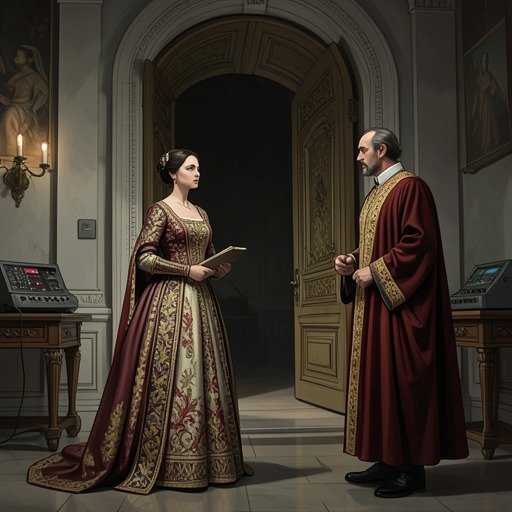
The narrator contrasts Anne’s conduct with the modesty and precedence expected of a woman of her birth. When the queen withdraws from a great hall, Anne remains among a circle of courtiers. She wears a deep-crimson French hood set with rubies and gold thread and a red velvet gown, and gives a shallow curtsey without joining Katherine’s train. Margaret initially moves to guide her out, thinking Anne has simply missed the moment; then she reads her stillness and smile as deliberate. The queen leaves with Princess Mary Tudor and the other ladies, and Anne’s choice to stay behind, permitted by Henry and not countermanded by Katherine, makes an established hierarchy appear suddenly altered.
This episode gives Anne a form of influence before her title formally changes. The narrator sees her not merely as a participant in courtly ritual but as someone testing what the king’s favor will allow. The scene’s force lies in the contrast between the formal procession—ranked by precedence—and Anne’s refusal to enter it. Her position is becoming visible in the space she occupies and in the deference the king does not require her to show.
Marriage, Status, and the Succession
Margaret’s account places Anne’s rise within the controversy over whether Katherine’s marriage to Henry was valid. Years earlier, Margaret Beaufort had angrily accused Margaret Pole and other women of fabricating evidence about whether Katherine’s first marriage, to Prince Arthur, had been consummated. The accusation mattered because a claim that the marriage had not been consummated could support Henry’s effort to marry his brother’s widow. The narrative records the dispute as a source of danger and factional suspicion, not as a question Margaret could settle by what she had witnessed.
Before Anne is recognized as queen, Margaret rejects the idea that the English court has an accepted place for a royal concubine or consort. In her judgment, Anne’s position is legally and morally compromised, and the most that could be conceded to her would be the style of the Lady and the ability to remain at court after Katherine had withdrawn. This is Margaret’s partisan assessment, not a neutral legal ruling; it registers how sharply the queen’s supporters resist treating Anne’s access to Henry as a legitimate change in status.
Anne’s standing becomes harder to dismiss when she stays at Suffolk House, the residence of Mary Tudor Brandon and Charles Brandon. Margaret hears that Anne is receiving visitors there, that Henry comes daily, and that dancing takes place nightly. The narrator suspects that Anne has effectively taken over the house, although she doubts that Mary Tudor Brandon would willingly have offered it as a platform for Anne. The episode conveys the court’s attention gathering around Anne before the official settlement is complete.
Her influence also reaches beyond her own household. Elizabeth Stafford, Duchess of Norfolk, tells Margaret that Anne has commanded the marriage of her daughter and that the king, in turn, commands her husband. The report presents Anne as exercising power through Henry’s authority over other nobles, including families that would otherwise expect to manage their own marriage arrangements. Margaret’s description is openly hostile, but the reported chain of command shows why Anne’s favor is experienced as a political force rather than merely a private attachment.
Henry’s campaign to set aside Katherine transforms that influence into a constitutional crisis. Thomas More resigns as Lord Chancellor after the Church surrenders to the king’s control, and the Pope is to be disregarded in England. Henry’s government then recognizes Anne as queen and Katherine as the Dowager Princess. When the king’s herald brings the news to Princess Mary Tudor, she is still correctly addressed as a princess in the sealed letter, a detail that briefly preserves the appearance of respect even as the settlement against her advances.
Queen Anne and Political Opposition
Anne’s elevation divides a court already unsettled by the contest over the succession. Margaret and her sons fear that Henry will disinherit Princess Mary Tudor and promote Henry FitzRoy as heir. Montague proposes that Geoffrey Pole travel with him to Calais and then carry information to Reginald Pole, the Pope, and the King of Spain. Their stated aim is to defend Katherine and Mary Tudor and persuade the Pope to act against Henry’s policy. Margaret recognizes that the family’s intermarriage and political connections can make them appear to be a faction or conspiracy, even as Montague presents their alliance as a defense of the old order.
The narrator’s opposition to Anne is inseparable from her loyalty to Katherine and Mary Tudor. She interprets Anne’s advancement as part of a threat to the queen’s marriage, the princess’s inheritance, and the authority of the Church. At the same time, she recalls having taught Henry to walk and having promised to protect his mother’s sons. Her resistance is therefore described not simply as hostility toward Anne, but as an attempt to recall Henry to obligations Margaret believes he is abandoning.
In spring 1533, the new archbishop rules Henry’s marriage to Katherine invalid, while John Fisher is arrested after arguing against the decision. The king’s message names Anne as queen and Katherine as the Dowager Princess. Margaret watches Mary Tudor assess the herald’s address before opening the letter; the princess is careful to confirm that it recognizes her rank. Her composed response contrasts with the political rupture the announcement represents. Anne’s queenship is established through a royal declaration, while its legitimacy remains contested by the Pope, Katherine’s adherents, and the family surrounding Margaret.
When Anne gives birth to a daughter, Elizabeth, in September 1533, Margaret takes the child’s sex as evidence that Henry’s political gamble has failed. She expects that, without a legitimate son, Henry might reconcile with Katherine and restore Mary Tudor’s place. She also believes the Pope’s ruling that Katherine’s marriage is lawful strengthens that possibility. Those hopes are the narrator’s expectations, not an outcome: Henry does not restore Katherine, and Anne remains queen. The birth nonetheless exposes the continuing pressure of male succession on Anne’s position and on the political meaning attached to her marriage.
Arrest, Trial, and Ending
After Anne loses a child, Margaret hears that Henry has said he believes God will not give him a son with her. She then learns of a more dangerous accusation: Henry claims Anne seduced him through witchcraft. The narrator recognizes how difficult such an allegation would be to refute, especially when made by a king. The charge turns the failure to produce a male heir into a supposed act of personal deception, making a dynastic problem available as a weapon against Anne.
Anne is arrested for adultery along with members of her court. The group includes Thomas Wyatt, Henry Norris, a young singer from her chamber, and her brother George Boleyn. Montague is distressed that so many people have been charged, and the arrests unsettle Margaret because she knows some of those implicated. The charges reach beyond Anne’s marriage and encompass people bound to her by family, service, or courtly association.
Montague agrees to sit on the panel of peers judging Anne, alongside twenty-five other lords. Thomas Howard, Anne’s uncle, chairs the proceedings. Margaret notes that many of her family’s associates support Princess Mary Tudor and oppose Anne, while the remaining peers are men Henry can be expected to direct through favor or hostility. The accusations include adultery and claims that Anne poisoned Katherine and intended to poison Mary Tudor. Elizabeth Somerset, Countess of Worcester, contributes an account of Anne’s flirtations in the queen’s bedchamber; Margaret characterizes the material assembled for the case as a mixture of gossip and scandal. She sees no realistic possibility of an impartial judgment and regards the evidence as shaped to secure a predetermined result.
Margaret initially imagines Henry as a humiliated lover, consumed by jealousy and grief at losing Anne. She then recognizes that this picture is wrong: while Anne is in danger, Henry is courting Jane Seymour, sending her gifts and dining with her. After the cannon announces Anne’s death, Henry marries again within days, and Jane becomes the new queen. Anne’s fall is thus presented not as the tragic end of a love Henry cannot relinquish, but as a swift political and personal replacement.
Narrative Significance
Anne’s story is organized around the instability of status. She first appears as a woman whose place in the royal household is contested; her refusal to follow Katherine’s train makes that contest visible; her recognition as queen then accompanies a reordering of marriage, church authority, and succession. The same court that permits her to stand apart from the queen’s procession later turns its attention to charges against her and the people around her.
The account also insists on the limits of Margaret’s perspective. Margaret’s labels for Anne and her confidence that Anne’s rise will collapse are openly shaped by her loyalty to Katherine and Mary Tudor and by her family’s political interests. Yet the narrative gives concrete form to Anne’s agency through her command of attention, her cultivation of a courtly following, and the influence attributed to her over marriage and rank. Her rapid removal, followed by Henry’s marriage to Jane Seymour, completes a sharp reversal: the woman who once appeared able to alter the rules of the royal court becomes subject to a judgment Margaret believes the king’s power has already decided.